
Technology
Filipinos are Asking AI Everything. Brands Should Worry About What It Answers.

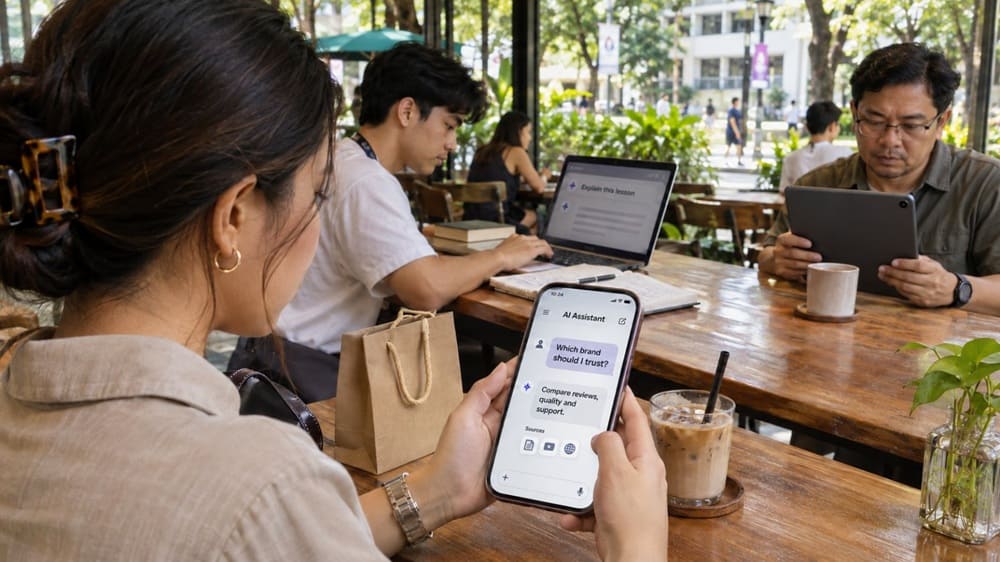
The Philippines has become one of the world’s most active AI markets, not because people are merely experimenting with chatbots, but because AI has slipped into the everyday rhythm of learning, searching, and making sense of information. According to the Digital 2027: Philippines report from We Are Social and Meltwater, 94.4% of Filipino internet users aged 16 and above used an AI tool in the past month, ranking the country fifth among 53 markets and well above the global average of 85.2%.
That scale creates a new challenge for businesses. Filipinos are not only using AI to find answers. They are increasingly treating it as a filter between themselves and the internet. And if AI becomes the first place people ask questions, brands can no longer control their story solely through their own websites, ads, or social accounts.
AI as a pocket tutor
The report’s most revealing finding is what Filipinos are using AI for. Finding information is the top use case at 71.7%, but learning or improving skills follows at 52.3%, ahead of saving time or increasing efficiency at 42.2%.
In other words, AI is functioning as a self-serve tutor: a tool for explaining a concept, practicing a skill, comparing options, or getting a tailored answer without opening ten browser tabs. For a young, mobile-first population, that makes AI feel less like a futuristic product and more like an extension of search and social media.
The curiosity is visible in search behavior too. “ChatGPT” was the third most-searched term on Google in the Philippines, while “AI” ranked eighth and “Gemini” thirteenth, signaling that people are actively trying to understand and navigate these platforms.
Curiosity, but not yet commitment
Yet widespread use has not translated into deep trust or paid loyalty. Only 5.5% of Filipino internet users pay for an AI tool, below the 9.5% global figure. Comfort with AI stands at 30.4%, roughly level with the worldwide average, and just one in three believes AI enhances their daily life.
Filipinos are also alert to the risks of an information environment increasingly shaped by algorithms and generated content. Among online news consumers, 65.8% say they are concerned about what is real or fake on the internet.
That combination, high usage, cautious belief, is the central tension. People will ask AI questions, but they may not automatically accept its answers. For brands, credibility now has to survive both human scrutiny and machine interpretation.
Social still sets the agenda
AI is not replacing the Philippines’ social-first digital culture. It is being added to it. TikTok added more Filipino users than any other platform over the past year, growing its adult audience by 22.4 million. Today, 84.8% of Filipino internet users use TikTok each month, more than double the worldwide figure of 36.1%.
Filipinos also use 8.4 social platforms per month on average, second only to the UAE. Social media remains the center of digital life, and video is increasingly where attention travels next.
That shift is already visible in referral traffic. YouTube now drives 49.9% of the web traffic that social platforms send to other websites in the Philippines, overtaking Facebook at 46.4%. Just a year earlier, Facebook accounted for 90.3%, while the current worldwide share remains 73.2%.
What brands should do now
AI is not yet the main path to purchase. Only 23.8% of Filipino internet users use AI tools as a main source when researching businesses, and 11.3% discover new brands through them. Consumer reviews lead at 49.0%, followed by social networks at 48.6% and search engines at 42.3%.
But those numbers describe today, not tomorrow. As AI becomes a default research layer, it will draw on the signals brands leave across the open web: reviews, social conversations, video content, news coverage, FAQs, product information, and public reputation.
The practical implication is simple: brands need to be legible to AI. That means maintaining accurate, consistent information; encouraging authentic reviews; publishing useful content that answers real customer questions; and monitoring how AI systems describe their products, services, and reputation. As Meltwater’s Mimrah Mahmood put it, businesses need to consider what these platforms say and how they shape company reputations.
The new reputation battleground
The Philippines offers an early glimpse of where digital behavior in Asia-Pacific may be heading. Filipinos have embraced AI at remarkable speed, using it to learn, solve problems, and get immediate, personalized answers. But their skepticism about online information means trust, not access, will determine which brands benefit from this shift.
The brands that win will not simply be the ones that appear in AI answers. They will be the ones whose answers are accurate, useful, and believable across AI tools, social video, reviews, and search alike.



You must be logged in to post a comment Login